M.Sc. · 2026
ABSTRACT
Design and implementation of an artificial intelligence-based camping reservation and route planning system M.Sc. Management Information Systems · Dokuz Eylül University · 2026
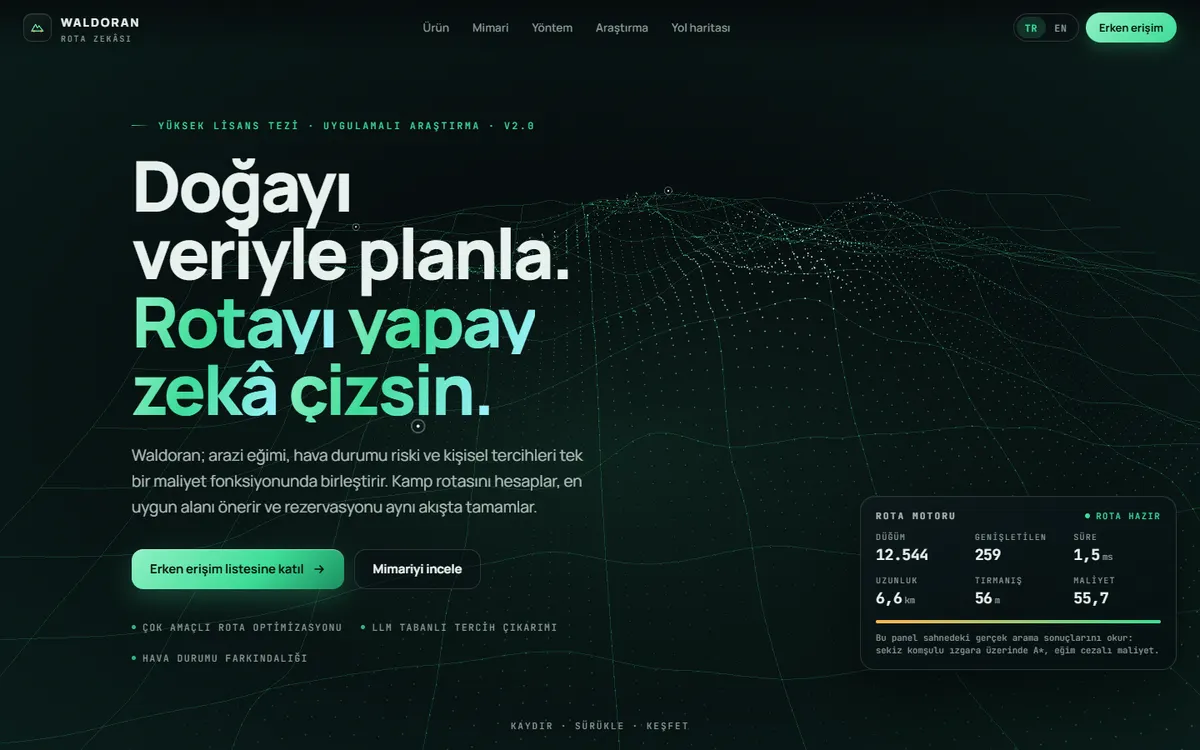
This thesis presents the design, development, and evaluation of the WALDORAN platform, which aims to reduce information asymmetry in the European camping and caravan tourism ecosystem, simplify multi criteria reservation processes, and enhance user experience through artificial intelligence. The methodological backbone of the study is the Systems Development Life Cycle (SDLC). The seven phases of the SDLC problem identification, information requirements determination, system needs analysis, system design, software development and documentation management, system testing and maintenance, and system implementation and evaluation were systematically applied to construct a holistic bridge between academic literature and sectoral application. This approach positions WALDORAN not merely as a software product, but as a methodological case study contributing to the Management Information Systems (MIS) literature. The backend architecture was built on C# 13.0 and .NET 8, following Domain Driven Design (DDD) principles in a five layered structure (API, Application, Domain, Infrastructure, Shared). User interfaces targeting three distinct stakeholder profiles (traveler, campground owner, administrator) were developed as three independent web applications using React 19 and TypeScript. Real time communication in reservation and notification flows was enabled through SignalR, while scheduled background jobs were handled via Hangfire. For the AI component, the Microsoft Phi-3.5 Mini Instruct model compressed using INT4 AWQ quantization was deployed locally through ONNX Runtime GenAI and DirectML, adopting an Edge AI approach. This architectural choice prevents user data from being transferred to central servers, establishing a privacy by design layer compliant with KVKK and GDPR. Route calculation was implemented through OpenRouteService API integration as the primary solution; in cases where the service is unavailable, a fallback mechanism based on the Haversine formula ensures service continuity. The WALDORAN data model represents the complexity of the sector through 15 business entities, 21 enumeration definitions, and over 100 campground attributes covering user, campground, reservation, payment, travel plan, and behavioral analysis domains. The system was evaluated using a multi dimensional approach: user acceptance testing with target user profiles, the System Usability Scale (SUS), API response time measurements, and AI inference performance analyses were assessed in combination. The SUS measurement conducted with 18 participants resulted in an average score of 88.5, placing the system in the "Excellent" usability category. The study demonstrates the practical applicability of running small language models (SLM) on edge devices, the adaptability of the SDLC methodology to AI driven sectoral projects, and the potential of AI based decision support systems in the camping tourism domain.
Smart tourism Computer architecture Information systems Decision support systems Machine learning Route optimization Artificial intelligence Software engineering
Read the full thesis (PDF, 3.6 MB)